


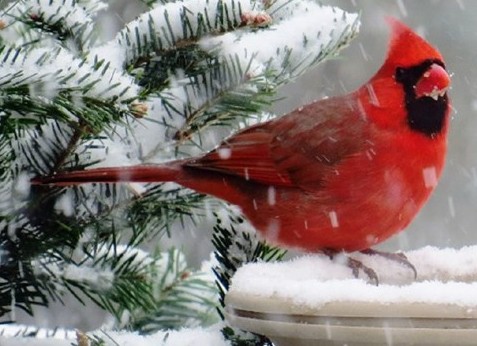
Now is the time to change the types of bird foods that are in your feeders, as well as the way your feeders are arranged. During these snowy months, making these changes will increase your viewing enjoyment, as well as help with the birds’ survival.
Chickadees and Cardinals are dependable, permanent residents each year. Other bird species tend to come from the boreal regions and have unpredictable, cyclic feeding patterns. Some species return every 3-4 years, while others return every 9-10 years. In some cases, these species can be “irruptive,” meaning they have years with unusually high numbers. Red-Breasted Nuthatches, Common and Hoary Redpolls, Pine Siskins, Red and White-Winged Crossbills, and Pine Grosbeaks can venture far from their normal ranges if seed availability is low.
Foods
Planning for winter bird feeding is easy; include large seeds, small seeds, and suet. Large seeds can include black-oil sunflower, striped sunflower, safflower, peanuts, shelled corn, and ear corn. Cardinal mixes tend to contain all three: sunflower, safflower, and peanuts. The large majority, about 80-90%, of bird seed used in our state is comprised of cardinal mixes and black-oil sunflower seeds. These mixes have a high-energy content and appeal to the widest variety of winter birds. One piece of advice: if you prefer to feed sunflower seeds, choose sunflower seed hearts instead. This will help you avoid the piles of sunflower shells below your bird feeders in the spring after the snow melts.
Seeds & Mixes
When changing your bird seed to accommodate the changing season, it’s most important that you change the millet proportions from 30-40% in the fall to about 10% in the winter. Migrant Sparrows and Juncos move farther south and are not typically your main visitors during the cold months. Another important note is that cracked corn or milo (sorghum) tends to attract sparrows and starlings, and is typically not recommended to have in your feeders. Instead, opt to scatter the millet on the ground or on tray feeders to attract Dark-Eyed Juncos, Mourning Doves, American Tree, Fox, Harris’s, Whitethroated,
and White-Crowned Sparrows. For American Goldfinches, Common and Hoary Redpolls, House and Purple Finches, and Juncos, niger seed (thistle) is a great all-winter staple. Commercial finch feeders can be used for all of the species listed above, but keep in mind that larger feeder ports will be necessary if you choose to feed Finch mix.
Suet
Suet, suet mixes, and peanut butter contain many nutritional benefits for wintering birds. Onion sacks, wire mesh feeders, wooden dowel (cage) feeders, and placing them on open platforms are great ways to feed suet. For Pileated Woodpeckers, solid platforms are preferred over suspended feeders. Peanut butter can also be used to fill log-style feeders or be smeared on pine cones. Remember to keep these items away from dogs and other “suet robbers.”
Another note, conventional suet feeders can sometimes attract European Starlings. This nuisance of an exotic species drives away native songbirds from your yard and from nesting cavities in the spring. If these birds are a problem, try using a feeder that forces the birds to feed upside down. Starlings have weaker feet and cannot feed in such a position, while Chickadees, Woodpeckers, and Nuthatches have no problem with this type of feeder.
Feeders
Water is a critical element to your feeding program during the winter. A thermostat and a heating feature are needed and can be found at bird-feeding supply stores. The best way to determine which feeder is right for your yard is to try several different kinds. The most popular kinds of feeders are platform or tray (covered or uncovered), hopper-style, and cylindrical. Many reliable designs can be made at home or bought commercially. Some of these designs feature platform feeders with screen bottoms for drainage or allow for up-close viewing that can be stuck to a window.
Feeder Layout
The main difference between fall and winter feeding when it comes to your feeder layout is placing the feeders closer to the home. Decks are a great place to put tray and fly-through feeders when the snow starts to accumulate. If placing feeders closer to the home increases the number of bird-window collisions, try the stick-on feeders or place the feeders within 1-2 feet of the window. This limits the amount of speed the birds can gather up and reduces the number of serious collisions.
When designing your layout, place 3-4 clusters of varying feeder sizes to accommodate the larger and smaller seeds, and suet. Be sure to include a ground feeding area in this group of clusters as well. The best feeder sites tend to be downwind of sheltering conifers like spruce, pine, and junipers, as well as switchgrass plantings, cattail marshes, or buildings. The conifers also provide areas for the birds to rest in between trips to the feeders.
Feeders should also be at least 10 feet from any type of heavy cover that predators like raptors or cats could hide in. If that’s not possible, encircle your feeders with 2 x 4-inch welded wire fencing that’s at least 30 inches high and has a diameter of 6-8 feet.